
Similar to my look at the MemoMind One glasses, I was pretty excited to see what Halliday could improve on when it comes to simple monochrome green HUD glasses that add a pretty important element for many people – speakers. While it would’ve been interesting to take a look at the unique projector Digiwindow solution they pioneered with their first generation glasses, it’s actually a relief to see that they went with the now much more common (and comfortable to use…) SRG waveguide solution for this second product – the Halliday G2 (HG2).
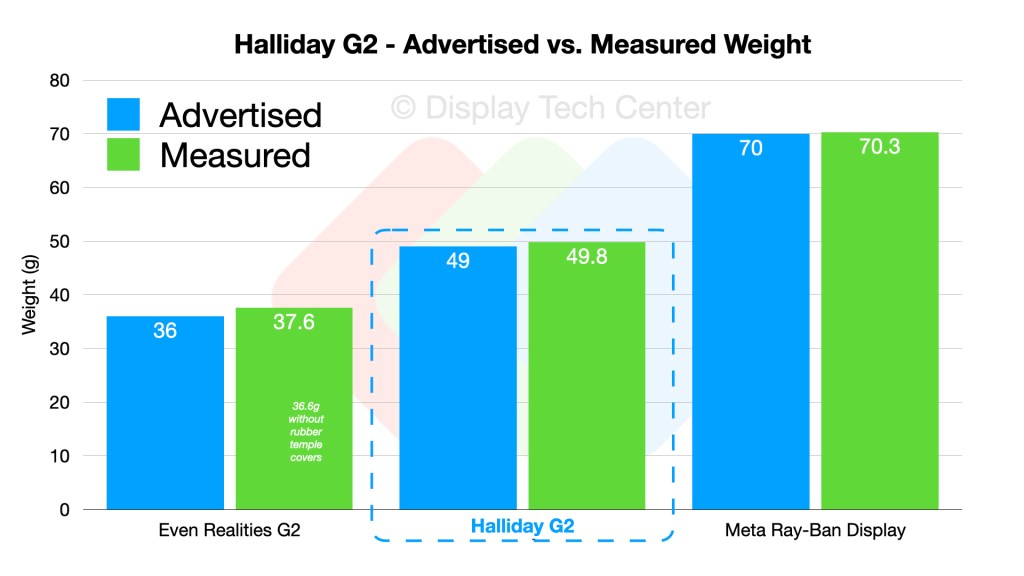
The build quality of the device is quite good, and they’re some of the only recent HUD glasses going with an acetate shell instead of the slim metallic frames that have been recently tried for lightweight glasses. The unit I had on my bench measured at 49.8g – while 12.2g higher than my daily driver Even Realities G2s (ERG2s), as I point out in the video I think we’ve reached a point where the spec race of the lightest glasses actually ends up being a detriment to those who leave out key hardware features like speakers. This means that I’m now of the opinion that the marginal ~10g adder that speakers provide is a worthwhile weight tradeoff for practicality of the device.
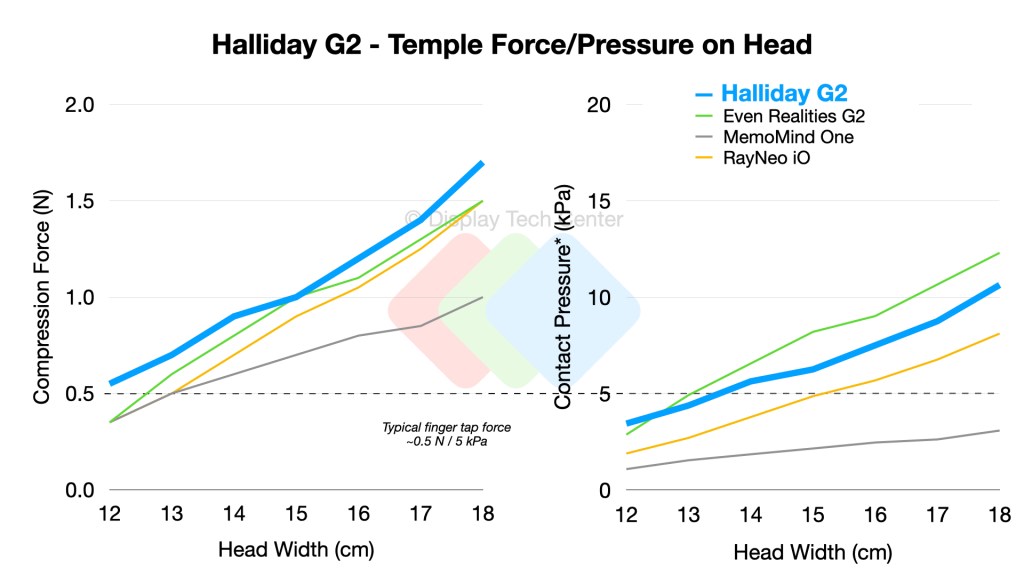
The HG2s have some of the highest measured clamping force to the head, with the temples applying up to 1.7N / 10.6kPa max at the widest 18cm head-width tested. However due to a relatively large contact area at the rear of the head, the applied pressure is even lower than my ERG2s and overall makes for a much more comfortable fit.
Speaking of speakers, the HG2s are incredibly loud at max volume measuring at 80 dBA in-ear, which is borderline unlistenable. Even at the medium setting, the 67 dBA in-ear output is quite loud, but surprisingly the leakage around the glasses is then reduced to <47 dBA even within ~1ft of the listener. I’m quite impressed at the directionality that Halliday was able to achieve with this pair vs. MemoMind, where an even quieter in-ear performance at this setting had up to 6 dBA higher leakage at this short distance.

In terms of spectral output of the audio, Halliday now takes the crown as the best smart-glass speakers we’ve tested (so far). The output in the below 100 Hz range is predictably awful, though that’s to be expected – it may be a little worse than the MemoMind Ones, but my baseline subtraction adds some noise to this already noisy bass region. What was impressive to see was that the HG2s have a modestly flat output all the way to 20 kHz, showing the best treble performance of any smartglass device tested to date!

In terms of battery, the HG2s have a pretty moderate power draw of ~110mW for audio at maximum output, which is pretty common for these audio modules. What surprised me was how high the power draw was for display-on applications like teleprompt, which in normal operation clocked in at ~400mW (using ~20% APL) – this is anywhere between 2-3x higher than comparative devices, and after the teardown this was clear to see why. The HG2s are using the JBD Gen1 monochrome green panels, notoriously more power hungry for the same target brightness value, which explains the higher power draw observed. Fortunately Halliday seems to know that this was going to be an issue and introduced a power saving mode, which reduced the power draw in the same test to ~250mW, extending the battery life by ~60% by hardware-limiting the maximum brightness of the device even at the maximum user-set brightness setting.

There’s not much to say about the display since it’s the same green JBD panel (Gen1 and Gen2 had minimal peak/FWHM deltas) with a green peak of ~526nm with a respectable FWHM of 32nm.

On the FoV side, HG2s advertise a strangely precise diagonal of 25.2°, which is close to what I’m measuring as well. In my home setup, the HG2s have a ~25° horizontal FoV and ~11° vertical FoV, meaning the measured diagonal FoV is around 27°. This means that now the HG2s are yet another brand that have undersold their effective FoV, and overall I’m just generally impressed that brands are underselling their specs in an environment that generally races to stretch marketing claims wherever possible.

I won’t spend any time on the optical path diagram – this has been the same now for MemoMind, Meizu, Even Realities and more, so take a look at any of those old posts for more details.

With that, we’re done with the analysis of the HG2 glasses – as always, you can find raw data over on Patreon for all tiers of supporters. Enjoy!

Leave a Reply